
Showing 25–36 of 58 publications
 Journal article2025
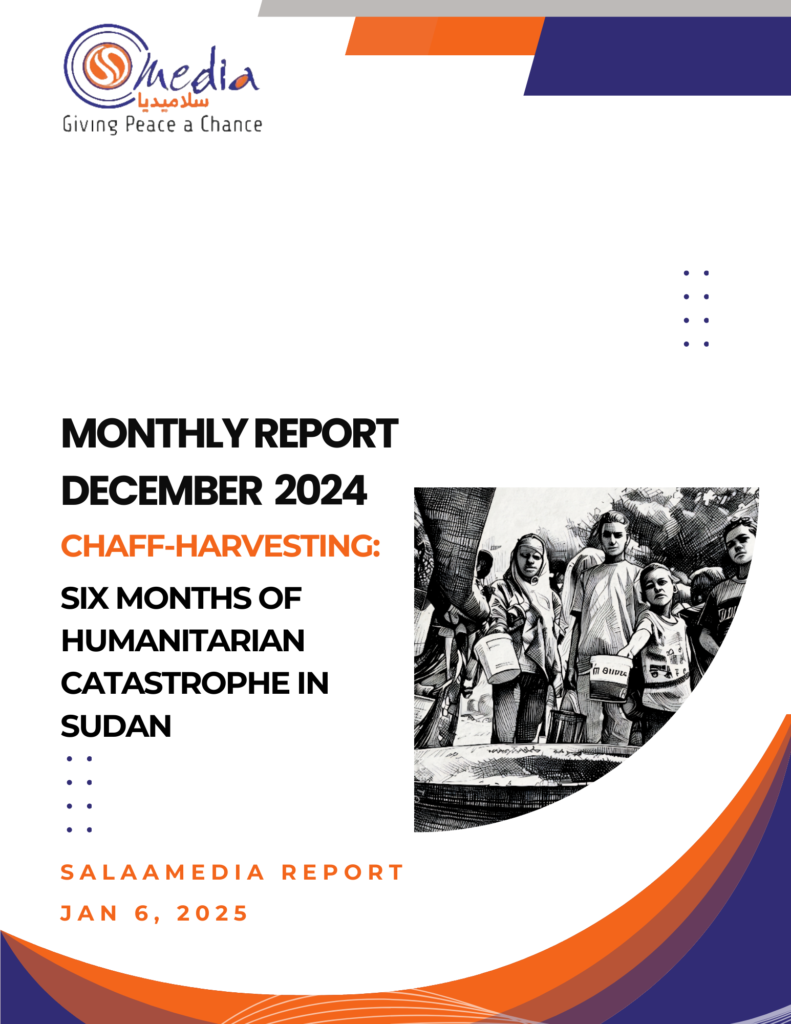
CHAFF-HARVESTING: SIX MONTHS OF HUMANITARIAN CATASTROPHE IN SUDAN
SalaaMedia Report
Flight bansHumanitarian aidHumanitarian situations
Abstract
The grave violations committed in Darfur around mid-2003 shocked, the global human conscience and led international organizations to accuse the head of the regime, his military officers, and the militias under his command of committing crimes of genocide and ethnic cleansing in the region. Two decades later, the entire country has been plunged into a grinding war that has spread to all regions, where indescribable atrocities have been – and continue to be – committed. Some observers of the conflict attribute the violence in Darfur, to environmental, political, social, and historical factors. These factors include accumulated negligence and marginalization of the region by central governments along with the drought in mid-1980s, which tore Darfur’s social fabric. This, combined with the steady population growth due to high birth rates and migration of desert nomads from the sub-Saharan belt into Darfur in search of land due to the drought, such factors led to the collapse of Darfur’s fragile social fabric. Since then, the fragile relationship between farmers and pastoralists in Darfur began to break down, leading to ethnic conflicts between the region’s components.
 Journal article2025
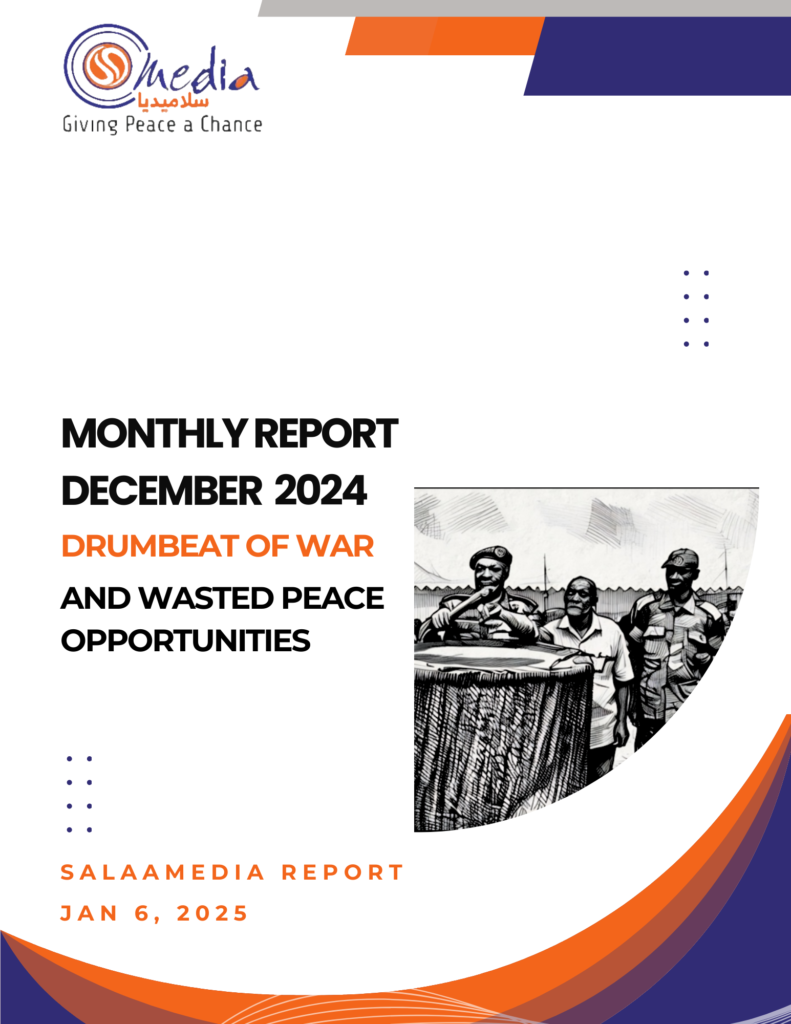
DRUMBEAT OF WAR AND WASTED PEACE OPPORTUNITIES
SalaaMedia Report
Abstract
Approaching the end of the second year of war in Sudan, humanitarian situation continues to deteriorate at all levels, leaving behind unimaginable tragedies, that it has been described as the greatest humanitarian disaster in modern human history. Not only did this war destroyed infrastructure and social relations but also put the entire young generations’ future at risk. Therefore, calls to stop the continuous shed of blood and resources become of great importance at all levels in order to shape the states and society future in Sudan.
This report relied mainly on previous reports by the SalaaMedia Center that reviewed the humanitarian situation in Darfur, peace endeavors and efforts made in this regard. It also includes subsequent developments; situations update, and its generated results and recommendations drawn from analysis of the data accumulated from the previous reports.
This report relied mainly on previous reports by the SalaaMedia Center that reviewed the humanitarian situation in Darfur, peace endeavors and efforts made in this regard. It also includes subsequent developments; situations update, and its generated results and recommendations drawn from analysis of the data accumulated from the previous reports.
 Journal article2024
DARFUR – WOMEN AGAINST DEATH
SalaaMedia Report
Abstract
The 52 years old, Sayedah Mohamed Hardimi, with her below 13 years old disabled daughter, were forced to leave their home in Al-Ma’had (B) neighborhood due to battles between the Sudanese Armed Forces (SAF) and the Rapid Support Forces (RSF) in Al Fashir town and recited to Zamzam Camp for internally displaced persons (IDPs) searching of safety. However, the mother and her girl again suffered terror and panic after the camp was subjected to artillery shelling by RSF for days in early December 2024. After taking refuge to Zamzam camp, the woman who teaches physics subject at secondary schools in North Darfur state, was unable to escape this time. She said in a video clip circulated on social media that; she and her disabled girl-child were unable to flee for the second time due to lack of money that would have enabled them to relocate to a safer place. She stated, “Artillery shells from four directions fell near the center of the camp where we live with others.” The loud sounds of the cannons were enough to terrify Sayedah and all the displaced people in the camp, forcing many of them to flee, leaving only her and some families, including disabled and elderly persons, with no options or means to move to a safe haven. The mother added, “Families who had financial abilities left the camp, while we do not have transportation fare.”
 Journal article2024
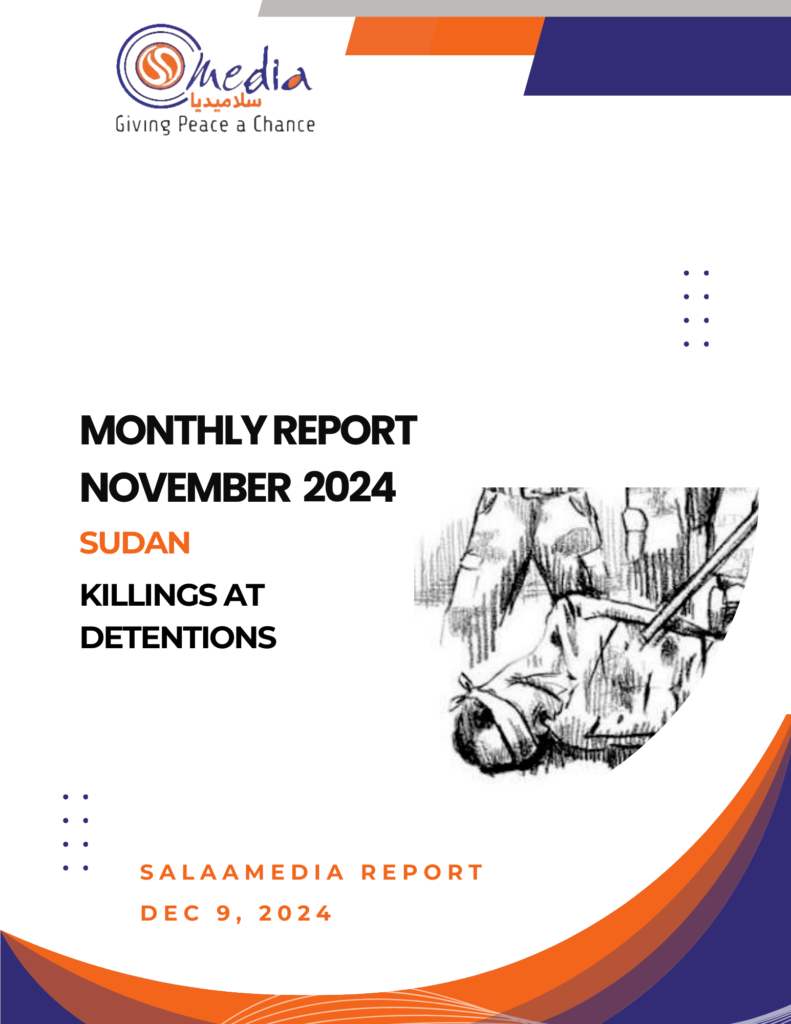
SUDAN – KILLINGS AT DETENTIONS
SalaaMedia Report
Abstract
It has been proven throughout the long history of human experience that violations that occur among civilians are the most prominent feature of many wars. Violations vary and take tragic forms, manifested in their most extreme form by depriving a person of his right to life. The current war in Sudan remains a strong testimony to the horror of these violations, especially in Darfur. The practices of both sides of the war, such as detention without legal support, torture that degrades human dignity, and even murder, have constituted one of the greatest disasters that humanity has witnessed recently. There is no doubt that the longer the war lasts, the more the rates of violations increase, the more diverse their forms become, and the more complex the ways to resolve them become. Civilians in Darfur had the largest share of violations compared to the rest of the regions of Sudan, due to the prolonged war there since 2003 AD. Arbitrary arrests, unlawful detention, kidnapping and enforced disappearance; It has become part of daily life in Darfur. These crimes committed by the parties to the war were accompanied by torture and starvation, which led to the death of a significant number of victims inside prisons and detention centers. In previous reports, the SalaaMedia team monitored more than 271 arrest crimes committed by war parties against civilians in the states of North and South Darfur. Later, the number of detainees in South Darfur rose to 353 people as a result of the application of the emergency law imposed by the civil administration in the state. This report particularly highlights the torture and death accompanying detention by warring parties.
 Journal article2024
WAR VICTIMIZES HIGHSCHOOL STUDENTS IN DARFUR
SalaaMedia Report
Abstract
Education is a recognized right in accordance with the Universal Declaration of Human Rights, in which Article 26 states: “Everyone has the right to education.” Despite this, there are only a few days left until the date of the Sudanese certificate exams (postponed) from the year 2023 AD; The Federal Ministry of Education announced its establishment on December 28, 2024, AD. The announcement of exams came despite the lack of clarity surrounding the future of students in several states in Sudan, especially Darfur. Which may lead to depriving them of their right to compete with their colleagues in the (relatively) stable states, and thus this will affect their right to education. Depriving Darfur students from participating in Sudanese certificate exams is a clear violation of the right guaranteed under the Universal Declaration of Human Rights.
In this report, the SalaaMedia team reviews the obstacles that students in the Darfur states face in applying and then sitting for the Sudanese certificate exams. This is due to a breakdown in communication between federal institutions and lower levels in areas outside the control of the armed forces. Controlled by support forces.
In this report, the SalaaMedia team reviews the obstacles that students in the Darfur states face in applying and then sitting for the Sudanese certificate exams. This is due to a breakdown in communication between federal institutions and lower levels in areas outside the control of the armed forces. Controlled by support forces.
 Journal article2024
DICPLACEMENT CAMPS UNDER FIRE
SalaaMedia Report
Flight bansHumanitarian situations
Abstract
Displaced people at camps in Darfur states, have not been spared the hell of the current war, despite the existence of clear provisions in international humanitarian law requiring their protection. The camps that were established as a result of the 2003 war, and the shelter centers in which citizens took refuge after the outbreak of the 2023 war, were subjected to attacks and artillery and air bombardment, by the parties to the war. Which led to hundreds of deaths and injuries and the complete destruction of some shelter centers, in addition to a number of homes and service facilities in the camps. The number of displacement camps in Darfur reached about 176 camps distributed among the five states of the region.
In this report, the Salaamedia team monitored the numbers of dead and wounded in the camps (Abushouk, Zamzam, Al-Hasahisa, Khamsa Daqaq, and Atash). Monitoring is limited to the period between April to November 2023 AD for the camps in the states of South and Central Darfur, and from April to November 2024, for the camps in the states of North and East Darfur. These are the periods within which the frequency of battles increased between the parties to the war in the cities of the region.
In this report, the Salaamedia team monitored the numbers of dead and wounded in the camps (Abushouk, Zamzam, Al-Hasahisa, Khamsa Daqaq, and Atash). Monitoring is limited to the period between April to November 2023 AD for the camps in the states of South and Central Darfur, and from April to November 2024, for the camps in the states of North and East Darfur. These are the periods within which the frequency of battles increased between the parties to the war in the cities of the region.
 Journal article2024
CASH FLOW – DEATH AND BANKRUPTCY
SalaaMedia Report
Abstract
The decision of the Central Bank of Sudan to change some denominations of the Sudanese currency sparked widespread reactions. This is because of its economic and political effects related to the war the country is witnessing. Although the Central Bank formulated a number of justifications for printing the new currency, including draining the markets of counterfeit currencies looted from banks, banks, companies, shops and homes. However, the decision may cause additional living suffering for civilians in conflict areas, especially the Darfur region, due to the Central Bank’s loss of the mechanism for distributing cash currencies throughout the country and its inability to send new denominations to those areas, where banks and banks have gone out of service. The battles that took place between the armed forces and the Rapid Support Forces in the main cities of the Darfur region led to the destruction of most of the bank branches after their balances were looted, and thus they were completely out of service. Which led to a scarcity of cash among civilians to the point of nonexistence due to the complete interruption of the periodic supply of banknotes to the cities of the region.
 Journal article2024
EFFECTS OF CLOSING ADRIE BORDER-CROSSING
SalaaMedia Report
Abstract
The three-month period specified by the Sudanese government to operate the Adre border crossing between Sudan and Chad ends by mid-November. Dr. Jibril Ibrahim, the Sudanese Minister of Finance, anticipated this date with a tweet on his account. He said, this crossing must be closed immediately until some arrangements are fixed including the presence of a team from the Customs Police, the Standards and Metrology Authority, and the Intelligence Service at the crossing, in addition to placing X-ray scanning devices to facilitate the identification of transit goods. This coincided with statements by government officials that there was no famine in the Darfur region, which indicates the government’s intention to close the crossing again. In this regard, the Sudanese Minister of Agriculture, Abu Bakr Al-Bushra, denied the presence of signs of famine in Sudan. He said, “Everything that is being raised about the existence of famine in Sudan is intended to open the borders and exploit that to bring in weapons and equipment for the Rapid Support Forces and pave the way for the entry of foreign forces, and this harms Sudan’s sovereignty.” This comes in light of calls from the international community to keep the crossing open for aid to enter the region, and the World Food Program said that it needs safe access and the flow of aid through all border crossings. In this report, Salaamedia Center monitors amounts of relief received by the states of Darfur through Adre crossing in the period from September 1, 2024, until now, in completion of the monitoring process carried out by the center since the opening of the crossing in the period from August 15 to August 30, 2024. In addition to researching the effects that closing the crossing might have on the humanitarian situation
 Journal article2024
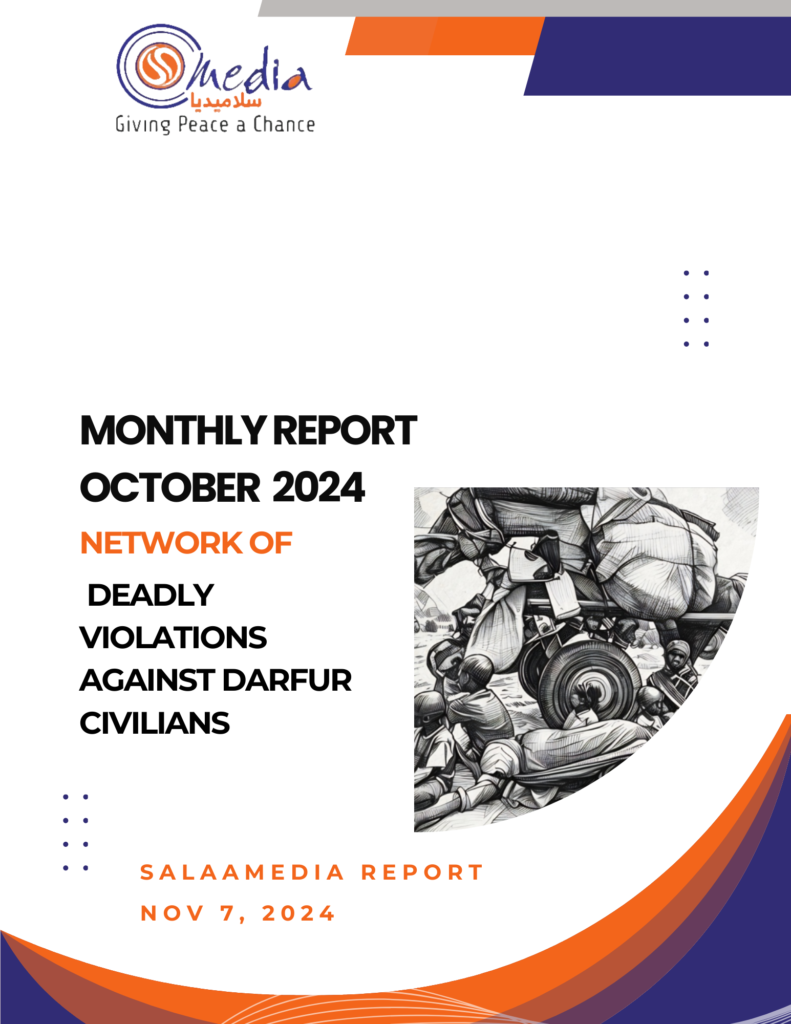
NETWORK OF DEADLY VIOLATIONS AGAINST DARFUR CIVILIANS
SalaaMedia Report
Abstract
Citizens in the Darfur region suffer from a severe shortage of food and basic materials, as well as a lack of necessary life-saving medicines, which has led to a noticeable increase in the deaths of mothers and pregnant women. Despite this, there is a loss of security and stability as a result of the violent fighting in the city of El Fasher between the armed forces and the joint force on the one hand, and the Rapid Support Forces on the other hand. The air strikes also worsened the conditions in areas where clashes had stopped, or which were under the control of the Rapid Support.
These conditions mask a growing humanitarian crisis, as displaced people and the communities hosting them suffer from severe food shortages, and women and children are unable to obtain necessary health care. Due to the disruption of the health system in the region. Regarding education, there is an estimated percentage of children who are not enrolled in school. Moreover, the rates of security incidents and disturbances have increased in areas not witnessing conflict.
This report summarizes the overall humanitarian disasters to which civilians in Darfur have been exposed as a result of the war and the armed forces’ warplane raids, especially calls from official authorities to close the crossings through which humanitarian aid flows. This resulted in disasters that put the people of Darfur in a spiral with almost no chance of survival. All these disasters surround the people of Darfur, and thus place huge responsibilities on the international and regional community. The most important of which is pressure to stop the war, in addition to the serious effort to provide humanitarian aid to save civilians from the danger of hunger, in addition to pressure for arrangements that preserve human life in the region from other dangers.
 Working paper2024
التطورات في علاقات الأرض، شمال دارفور الفترة 1994-2024
أ. محمد بدوي
Abstract
تطورات علاقات الأرض في ولاية شمال دارفور، تستدعي تقصي الخلفية التاريخية لملكية الأرض من عدة زوايا، بما يتيح النظر إلى الأسباب المختلفة المرتبطة، التي أهمها مفهوم الملكية سواء في ارتباطاتها التاريخية بالقانون العرفي، وواقع ما قبل فكرة الدولة وارتباط الهوية بملكية الأرض.
أثرت الحروب السياسية في السودان ودول الجوار في تشكيل طبيعة علاقات الأرض من لجوء ونزوح شكل وجودا جديدا وفراغا تم ملؤه بمستوطنين جدد أو فراغ مستمر بفعل اللجوء المتطاول والمتكرر، الذي في بعض تطوراته قاد إلى استغلال بعض الأرض ليس للاستيطان لكن لإنشاء قواعد عسكرية مثل قاعدة الزرق بشمال دارفور، وما سبق ذلك من صراعات حول الملكية التاريخية المرتبطة بمناطق بدء استغلال الموارد الجديدة مثل الذهب، وعلاقات الملكية الناتجة من انتهاكات للحقوق الاقتصادية والاجتماعية مثل ظواهر سوق المواسير والتعامل في السيارات المستعملة المستوردة بلا ضوابط من دول الجوار، يقرأ ذلك في ظل تحولات المراكز الاقتصادية سواء المرتبطة بالسلطة أو اقتصاد الصراعات المسلحة، والتداول في أمد النزوح وامتداد المدن لتلتحم بالمعسكرات وتنتج شكلا جديدا في الملكية وإن لم يتم التدخل بعد لكن حتما كما في السابق ستصبح أحزمة مؤقتة للمدن قبل أن تتحول إلى جزء من الضواحي لاحقا لأسباب مختلفة منها غياب المعالجات والحلول، وتراجع الاستقرار والتحولات في نسق علاقات الإنتاج وكسب العيش، والتنافس الحاد في الملكية للأرض الحضرية.. والتجربة التي ظهرت خلال الفترة الانتقالية في شمال دارفور في ذاك السياق.
تسعى الورقة على التركيز منذ العام 1994م.(1) إلى الراهن، مستندة على أن ذلك التاريخ يمثل نقطة تحول حادة وجوهرية تكشف الكثير مما حدث لاحقا إلى الراهن.
 Working paper2024
تأثير النزاع المسلح على الأرض والبيئة
أ. محمد سعد الله عبد النبي
Abstract
خلّف النزاع المسلح الحالي في السودان بين الجيش والدعم السريع المندلع في منتصف أبريل 2023، آثارا عميقة ومتعددة الأوجه على الأرض والبيئة في أقاليم البلاد المختلفة، لا سيما في إقليم دارفور. تبحث هذه الورقة في الآثار البيئية السالبة للنزاع المسلح الحالي، وتسلط الضوء على تلوث البيئة، تدهور الموارد الطبيعية، وفقدان التنوع البيولوجي، وتعطيل الممارسات التقليدية لاستخدام الأراضي. أدى العنف وعدم الاستقرار الذي نتج من النزاع المسلح الحالي إلى تدهور كبير للغابات والتربة، وإزدياد رقعة التصحر على نطاق واسع حسب إفادات المواطنين الموجودين في ولايات دارفور المختلفة، ومن الذين نزحوا من منها. أدى ذلك أيضا˝ إلى زيادة الهشاشة للمجتمعات المحلية التي تعتمد أساسا˝ على مهنتي الزراعة والرعي كمصدر رزق. علاوة على ذلك، أدى النزاع الحالي إلى تشريد السكان من مدنهم وقراهم إلى تكثيف الضغط على الموارد الطبيعية المتبقية، مما أسهم في الاستغلال غير المستدام وزيادة التنافس على الموارد الطبيعية بشكل عام والأرض بشكل خاص. على الرغم من الصعوبات في الحصول على المعلومات الأولية من السكان الموجودين حاليا˝ في دارفور، نسبة لانقطاع شبكات الاتصال، إلا أننا تمكنا من طرح استبيان على عدد محدود من المواطنين من ولايات دارفور، وكنا نتمنى الوصول إلى أكبر عدد من العينات لولايات دارفور الخمسة ويمكن أن يتم ذلك إذا تم توسيع هذه الورقة. توظّف هذه الورقة مراجعة الأدبيات والمراجع ذات الصلة بالنزاع، بالإضافة إلى المشاكل البيئية في نطاق إقليم دارفور، وكذلك المقابلات الفردية مع عدد من المواطنين من المجتمعات المتضررة من النزاع الحالي، سواء موجودة في مناطق النزاع أو نزحت إلى مناطق آمنة أخرى، بالإضافة عدد محدود من صور الأقمار الصناعية وذلك لتقديم تحليل شامل للأزمة البيئية في دارفور. تؤكد النتائج الحاجة الملحة إلى ضرورة وضع استراتيجيات متكاملة لحل النزاعات والإدارة البيئية، للتصدي للتحديات المتداخلة والمتشابكة بين النزاع المسلح والتدهور البيئي بعد نهاية النزاع الحالي في السودان، يتم ذلك من خلال توضيح الأبعاد البيئية لنزاع دارفور، وبالتالي تسهم هذه الورقة في الخطاب الأوسع حول بناء السلام المستدام والقدرة على الصمود وبناء المرونة للمجتمعات المتضررة من النزاع في السودان.
 Journal article2024
DARFUR – MULTIPLICATION OF VIOLATION FACES
SalaaMedia Report
Abstract
Civilians in Darfur region have been exposed to violations by the parties to the war under the pretext of cooperation with any of the warring parties. It is accompanied by a clear violation of freedoms, such as detentions, deprivation of communications services and restriction of movement within the region and out.